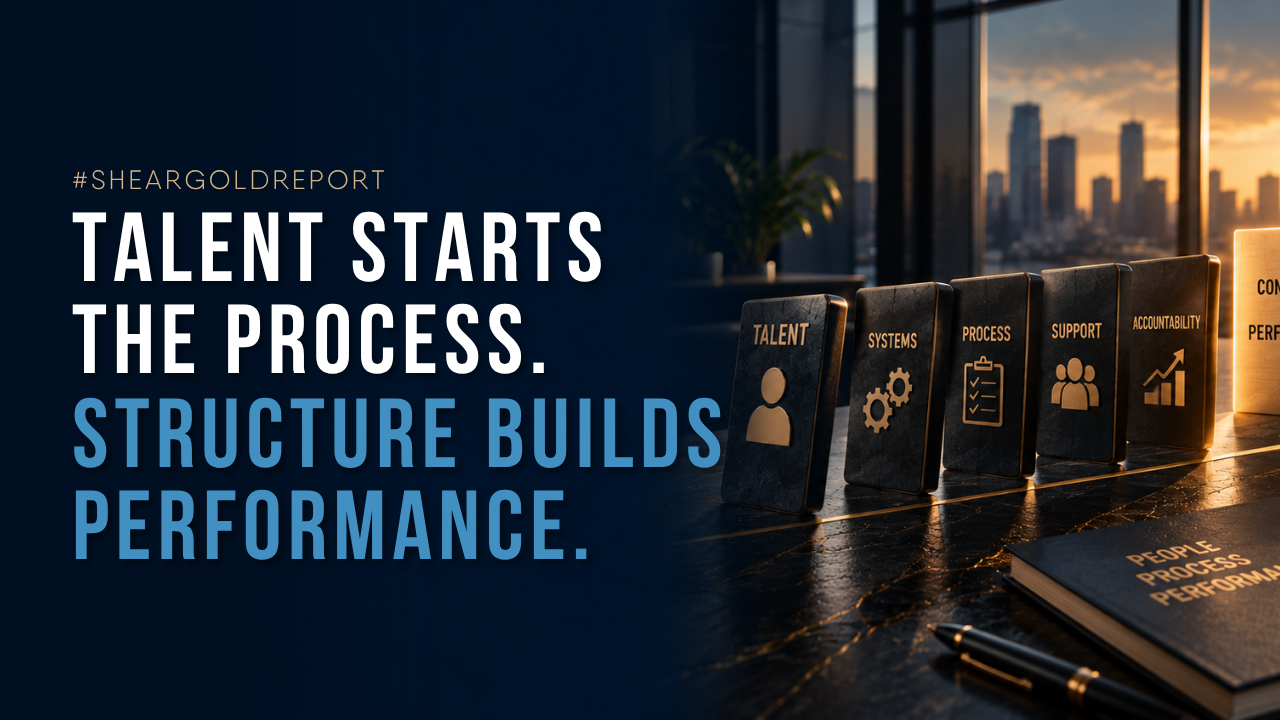
Talent Starts The Process. Structure Builds Performance.
Sep 15, 2026Here’s a pattern I see play out across businesses every week: leaders convince themselves that their next growth phase hinges entirely on making their next key hire.
We look for the natural lister, the charismatic negotiator or the operator who brings immediate energy into the room. We put together an attractive remuneration package, hand over the desk and expect their natural capability to carry the business forward.
Talent certainly gets things moving. It generates enthusiasm, opens early doors and brings raw capability into the organisation.
Talent starts the process. Structure builds performance.
Natural ability might get you off the mark, but it’s the structure around that person that determines what happens next.
Without it, you get inconsistency. Great weeks followed by quiet weeks. Strong performers becoming frustrated. Leaders constantly stepping in to solve problems, manage people and keep things moving.
The question isn’t simply:
“How good is the person?”
It is:
“What environment have we built for that person to perform in?”
Three disciplines that create consistent performance
- Replace mood with rhythm
High performance shouldn’t depend on whether someone is having a good day.
Build a rhythm that makes the right activities happen regardless.
Regular pipeline reviews. Non-negotiable prospecting time. Consistent client follow-up. CRM updated as part of the process, not when someone remembers.
When the rhythm is right, execution becomes less about motivation and more about habit.
- Protect the people who produce the dollars
One of the quickest ways to lose good people is to bury them in work that doesn’t require their capability.
If your best people are spending hours chasing paperwork, solving admin issues or dealing with problems that someone else could own, you’re wasting some of your most valuable capacity.
Build the support around them so they can spend more time doing what they do best:
Listing. Negotiating. Connecting. Growing relationships.
- Make accountability part of the system
Accountability shouldn’t be a difficult conversation that happens once someone is already off track.
The standards need to be clear from the beginning.
What does good look like?
What activity is expected?
What does the pipeline need to look like?
How quickly do we follow up?
What information needs to be in the CRM?
When those expectations are built into the way the business operates, accountability becomes less personal.
It’s simply the way we do business.
The leadership responsibility
As a leader, your job isn’t to constantly motivate talented people or manage the ups and downs of individual performers.
Your job is to build the environment in which good people can consistently perform.
Talent can get you moving.
But structure creates consistency.
And consistency is what turns individual performance into a scalable business.
So before you spend more time, money and energy looking for your next great hire, take a look at the business they’re going to walk into.
Are the systems, standards and rhythms strong enough to support their talent?
Because even great people struggle in a poorly designed business.
Build the structure.
Then give good people room to perform.