The “Teamwork At 4:00 Pm” Illusion: Why Culture Is An Operating System, Not A Calendar Event
Oct 19, 2026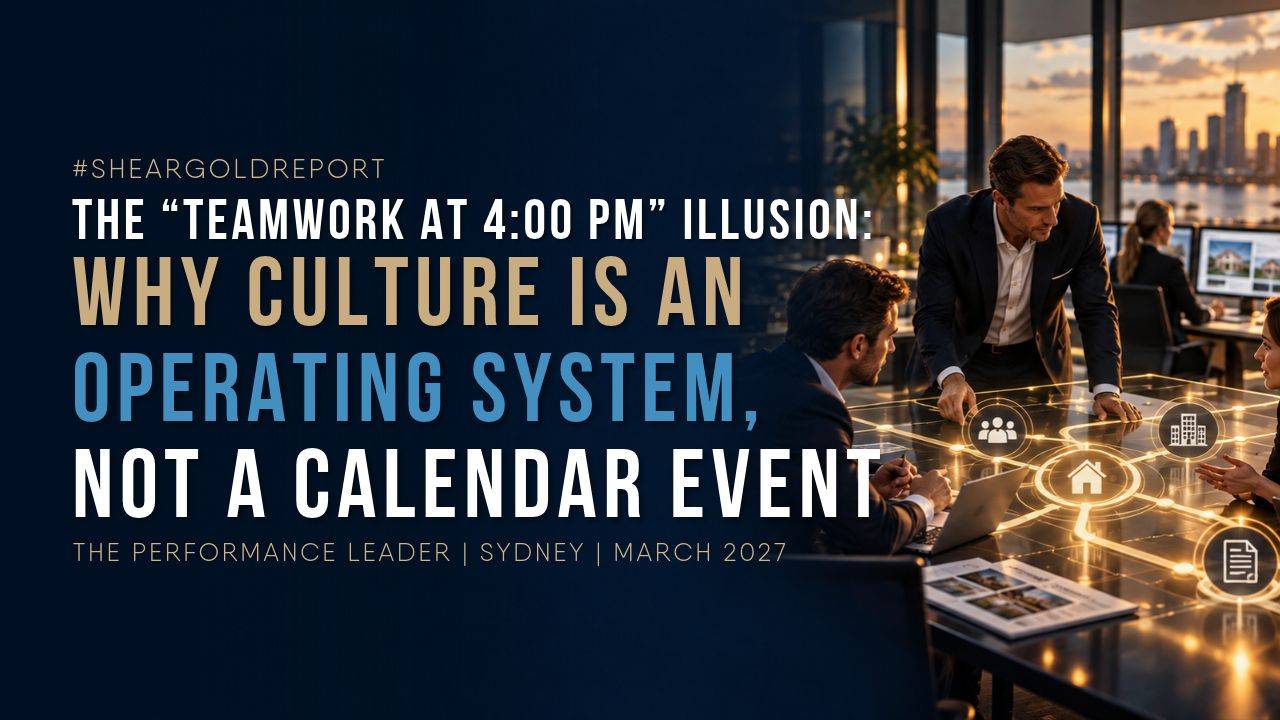
During a coaching session a while back, an agency leader was walking me through her daily diary.
She pointed to her calendar with complete confidence.
“I do my pipeline calls in the morning, my admin after lunch, and then I do my teamwork stuff between 4:00 and 5:00 each day.”
I stopped her right there.
“Hang on a minute,” I said. “Listen to what you’ve just said.”
She repeated it, a little more slowly this time.
“You don’t ‘do’ teamwork between 4:00 and 5:00 PM,” I told her. “Teamwork isn’t a calendar appointment. It’s not another task to tick off before you head home. Either you operate from a foundation of great teamwork, or you don’t.”
That conversation highlights a common misconception in real estate leadership: the belief that teamwork and culture are activities to be scheduled, rather than standards that underpin the way the business operates every day.
The Compartmentalisation Trap
When a leader treats teamwork as another box to tick, it’s not hard to predict what happens between 8:30 AM and 4:00 PM.
- Sales agents operate in their own silos, protecting their buyer pipelines and keeping information to themselves.
- The sales team and property management team work in separate worlds, despite serving the same clients and contributing to the same business.
- When pressure builds and client transactions become difficult, people focus on protecting themselves rather than supporting their colleagues and finding the best outcome.
Then 4:00 PM rolls around.
The principal organises some snacks, opens a bottle of wine on Friday, or brings everyone together for a thirty-minute “collaboration huddle.” There’s a bit of conversation, a few laughs, and everyone heads home feeling as though they’ve invested in team culture.
But have they actually changed anything?
Teamwork isn’t Friday night drinks. It isn’t an annual team-building day. And it certainly isn’t an hour of conversation squeezed into the end of the day.
Those things can help people build relationships, but real teamwork is demonstrated in the way your business operates.
If your people don’t collaborate when a listing is on the line, communicate respectfully when an inspection falls apart at 10:00 AM, or uphold the same standards across every department, you don’t have a high-performing team.
You have individuals working under the same roof, each doing their own thing.
Three Shifts: From a Scheduled Task to an Operating Standard
- 1. Teamwork Is How You Handle Daily Workflow, Not Social Hour:
Real teamwork shows up in the everyday moments that keep your business moving. How effectively does a sales agent hand over an investor lead to the business development manager? How readily does an agent step in to cover an inspection when a colleague has an urgent family commitment?
When teamwork is part of the way your business operates, people stop asking, “Is this my job?” and start asking, “What needs to happen to deliver the best outcome for the client and the business?”
That’s a very different way of operating. - 2. Culture Is Revealed Under Pressure, Not at Rest:
It’s easy to talk about teamwork between 4:00 and 5:00 PM when the pressure has eased and the day is winding down. The real test comes at 11:15 AM on a chaotic Thursday, when a solicitor is threatening to pull a contract, a landlord is frustrated, and the phones won’t stop ringing.
How do your people respond? Do they communicate, take ownership and help each other find a solution? Or do they point fingers, make excuses and retreat into their own corners?
Your culture isn’t defined by what happens when everything is going well. It’s revealed by how your people respond when things get difficult. - 3. Build Shared Scoreboards, Not Isolated Islands:
You can’t expect people to work as a team if the way you measure and reward performance encourages them to work as individuals.
If your displays only celebrate individual GCI while overlooking property management growth, operational excellence and cross-departmental referrals, you’re sending a clear message about what matters most.
Build scoreboards that reflect the overall performance of the agency, not just individual results. Help your people see how their contribution connects to the success of the wider business. When everyone understands that one department’s performance affects the whole agency, collaboration becomes more than a nice idea. It becomes part of how you win.
The Operational Standard
Talent gets you started, but the right structure turns talent into consistent performance.
Stop treating teamwork as an afternoon activity or a secondary item on the meeting agenda. You can’t spend most of the day allowing people to operate in isolation and expect an hour of scheduled collaboration to make up for it.
Teamwork should be evident in every phone call, every client interaction, every handover and every standard your people uphold.
It’s not something you switch on at 4:00 PM. It’s the operating standard that guides how your business runs throughout the day.
Get that right, and your 4:00 PM check-in becomes a whole lot less important.
Installing Your Leadership Playbook: The Performance Leader
Building an agency where collaboration, accountability and high performance are part of the everyday rhythm doesn’t happen by accident.
It requires leaders who know how to set clear expectations, establish the right structures and create an environment where people take ownership of their contribution to the bigger picture.
That doesn’t come from another motivational speech or by putting “teamwork” in the diary. It comes from deliberate leadership.
Next March, I’ll be running The Performance Leader in Sydney.
It’s an intensive, two-day masterclass designed for agency principals, directors and leaders who want to move beyond managing the day-to-day and build a business that performs consistently, with or without their constant involvement.
Across two days working directly with me, you’ll develop the framework to:
- Break down departmental silos and establish clear standards that get everyone working towards the same business objectives.
- Lead more effective coaching conversations that connect individual goals with the performance of the wider agency.
- Put the right structures, meeting rhythms and performance displays in place so accountability, collaboration and consistent execution become part of the way your business operates.
If you’re ready to move beyond managing individuals and start building a more aligned, accountable and high-performing agency, join me in Sydney.
The Performance Leader | Sydney | March 2027
Strictly capped to ensure deep, individual coaching with every attendee.
Speak with our team directly or register your interest today before allocations close.
Looking across your business right now, is teamwork something your people occasionally "do" when it is convenient, or is it the unshakeable standard from which they operate every single hour?