
The Friction Factor: Why Property Management is Actually a Conflict Resolution Business
Jul 27, 2026In last week’s edition of The Sheargold Report, we broke down a massive shift reshaping the Australian and New Zealand property landscapes: the transition from IQ to EQ as the ultimate predictor of success. We established that while technical knowledge (IQ) might get you into the room, it’s your emotional intelligence (EQ) that determines how long you get to stay there.
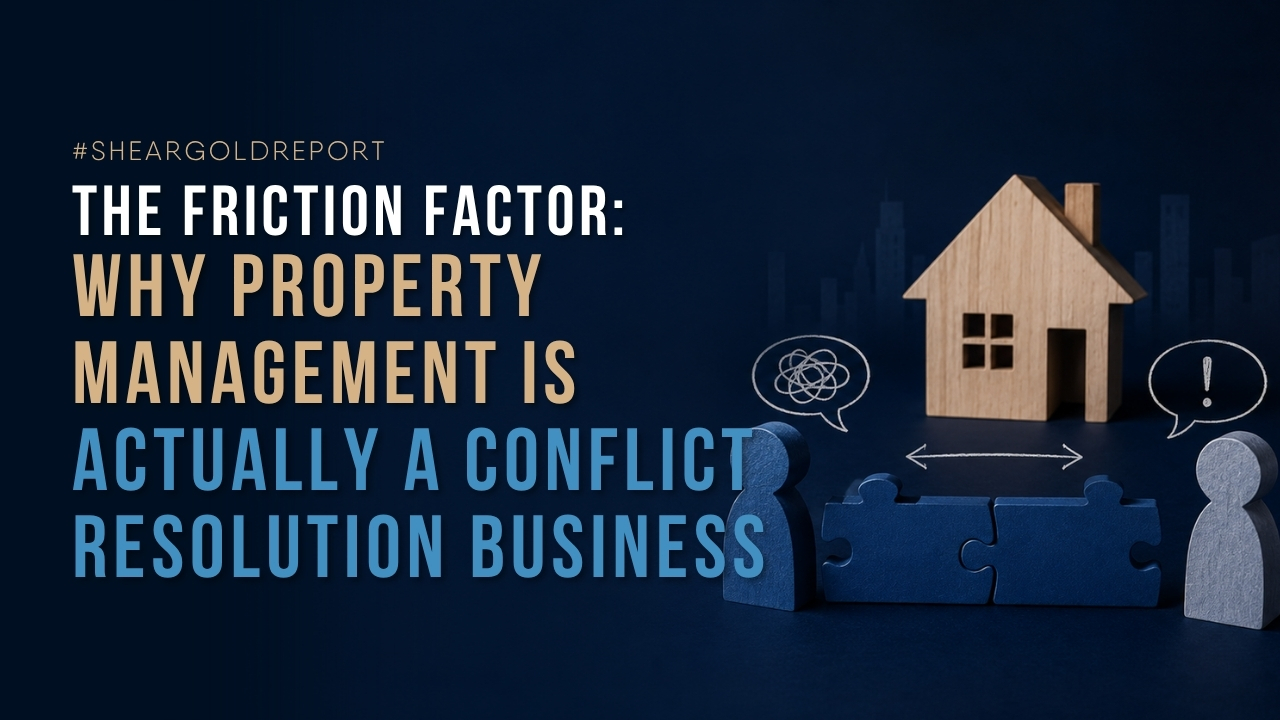
Nowhere is this truth more raw, or more urgent, than in Property Management.
For years, the industry treated property management like a pure administrative function. The traditional view was that a great PM simply needed a high IQ: an airtight grasp of the local residential tenancies legislation, sharp attention to detail on routine inspection reports, and the ability to process a maintenance request accurately.
But if you ask any elite Property Management leader today what their team actually spends their energy on, they won't tell you it’s paperwork. They will tell you it's people.
Strip away the software and the rent rolls, and property management is fundamentally a high-stakes conflict resolution business. And in conflict, IQ alone is ineffective.
The Anatomy of Property Friction
Think about the unique environment a PM operates in every single day. You are managing the intersection of two deeply emotional human triggers:
- The Landlord: Protecting their significant, often high-stress financial asset.
- The Tenant: Securing their home - their place of safety, sanctuary and family.
When a pipe bursts, rent falls behind, or a bond dispute arises, these two worlds collide. The landlord experiences financial anxiety; the tenant experiences lifestyle disruption.
An administrative, IQ-led approach to this friction relies entirely on leverage and legislation. It looks at the contract, quotes the Act, and delivers a cold, binary answer. The result? Escalation. The tenant digs their heels in, the landlord threatens to move their portfolio to a competitor, and the property manager finishes the day exhausted, burnt out and looking at job boards.
Shifting the Mantra: You Are Paid for the Problems
When property managers hit this wall of burnout, it is usually because of a fundamental misunderstanding of their job description. They roll into the office hoping for a day with no screaming tenants, no demanding landlords and no broken maintenance requests. When the opposite happens, they feel defeated.
But elite property management teams operate under a completely different mantra: You are not paid to do the paperwork. You are paid to deal with the problems.
If every tenant paid on time, every property stayed immaculate, and no maintenance ever occurred, the landlord wouldn't need an agency. They would just use an app. The administrative tasks—the leases, the entries, the forms—are just the baseline. The real value you bring and the exact reason the agency is paid a management fee, is your ability to step into the mess and fix it.
Once a PM truly internalises this, their relationship with stress changes. A difficult phone call isn't an interruption to their day; it is their day. And navigating that problem requires a shift from pure IQ to elite EQ.
The EQ Counter-Approach: Defusing the Emotion Before the Problem
When a PM steps into the arena armed with elite EQ, the playbook changes completely. They recognise that you cannot solve a logical problem while a client is in a state of high emotion.
High-EQ property managers don't manage properties; they manage expectations and emotional states.
- They Validate First: Before offering a solution to a furious landlord or a distressed tenant, they use emotional labeling to lower the temperature. A simple, "I understand this unexpected cost is incredibly frustrating, especially right before the end of the financial year," completely changes the dynamic of the call.
- They Listen for the Subtext: High-EQ PMs don't listen to respond with the rulebook. They listen to understand the underlying fear driving the aggression.
- They Protect the Relationship Asset: By defusing the conflict through empathy rather than fact friction, they anchor client retention. Landlords don’t leave agencies because a hot water system broke; they leave because they felt their anxiety was dismissed.
The Weekly Blueprint: The "De-escalation Framework" for PMs
To lean into this superpower this week, coach your PM team to ditch the standard script during a dispute and follow three high-EQ steps:
- The Acknowledgment Buffer: Start the response by naming the emotion in the room. Never jump straight to the facts. Let them vent for 30 seconds without interruption.
- The Alignment Pivot: Move onto their side of the table by stating a shared objective. (e.g., "Our goal here is to get this sorted as quickly as possible so your weekends aren't disrupted, and we protect the property's value.")
- The Collaborative Solution: Present options rather than directives. Giving an anxious client a sense of control immediately suppresses their fight-or-flight response.
The Bottom Line: Automation can handle your routine text alerts, your trust accounting, and your inspection bookings. But algorithms cannot de-escalate a human crisis. In property management, conflict is inevitable, but combat is optional. The teams who master the EQ of conflict resolution are the ones who will own the future of asset management in your market.