
The Leadership Premium: How to Build an Environment for Achievement
Jul 13, 2026Every real estate agent wants the outcome. They want the pristine whiteboard filled with "Solds", the glittering awards at the annual gala, and the prestigious market share that cements their reputation.
But as leaders, you know the cold, hard truth: They don’t always want to do the inputs required to get there.
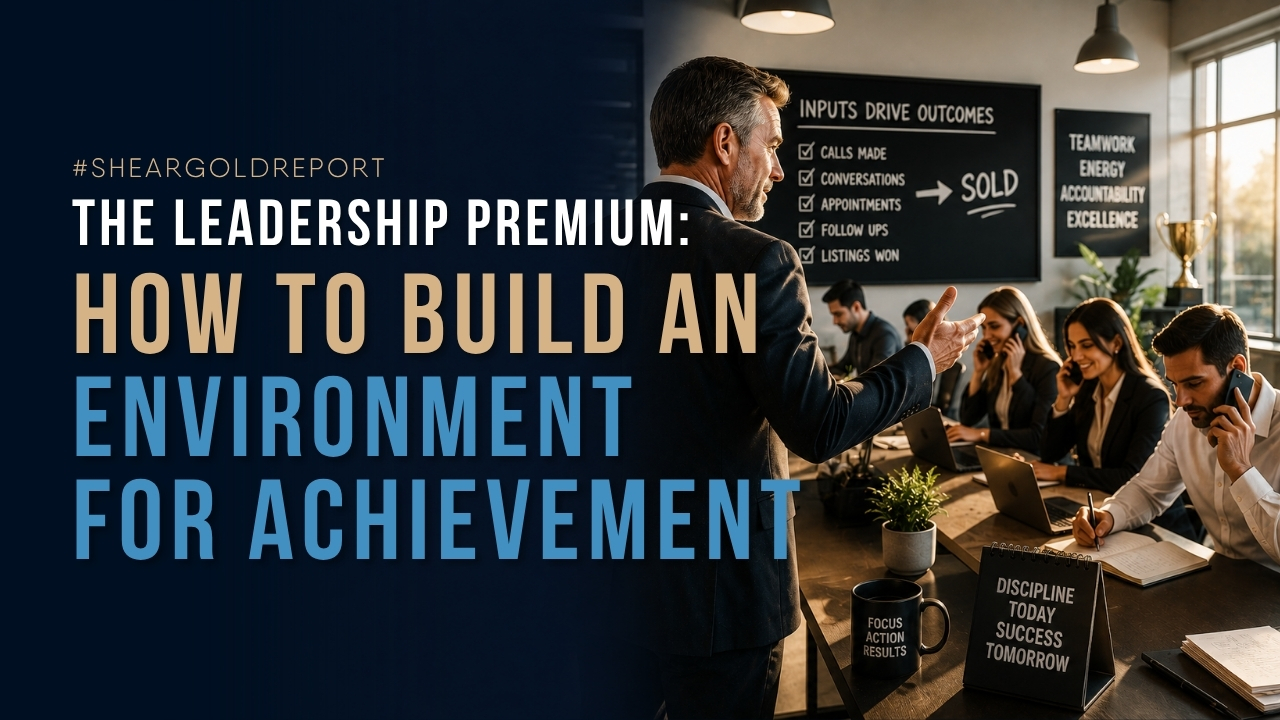
They don’t want to make the extra twenty prospecting calls on a rainy Tuesday afternoon. They don’t want to systematically update their database, or lean into the awkward, uncomfortable follow-up conversations with cold leads.
This brings us to one of the key questions you must ask yourself as a principal or leader: Is the environment right for achievement?
One of a leader’s absolute superpowers is helping their people do things they simply would not do without support. If your team only does what is comfortable, your business will plateau. Your true value as a leader is found in your "Leadership Premium"—your ability to bridge the gap between their current comfort zone and their true potential.
So, how do you actually support your team to do the things they don’t want to do? It requires shifting from a manager who demands results to a Talent Amplifier who builds an environment where action is inevitable.
1. Gain Permission for Accountability
Accountability is not something you inflict on people; it is an environment you invite them into. If you try to force an agent to make prospecting calls without their explicit permission, you will be met with resistance, friction, and hidden resentment.
Great leadership coaching models itself after elite sport. A high-performance sports coach doesn't yell from the sidelines without context—they hold athletes accountable to the goals the athlete set for themselves.
Sit down with your agents individually. Reconnect with their personal vision. Once they tell you exactly what they want to achieve (the outcome), ask for their permission to hold them to it:
"Since you've told me your goal is to secure three new listings a month to pay off your mortgage, do I have your permission to call you out when I see your prospecting inputs dropping?"
When you have permission, accountability stops feeling like micromanagement and starts feeling like profound support.
2. Recognise the Input, Not Just the Outcome
One of the most common mistakes leaders make is only celebrating the final results—the signed agency agreements and the unconditional contracts. When you only celebrate outcomes, you accidentally demotivate the people who are working hard on the inputs but haven't seen the reward yet.
In real estate, there is a massive "lag time" between action and result. It is exactly like turning on a hot shower; you turn the tap, but you have to stand under the cold water for a minute before the heat kicks in. If an agent loses heart during that cold-water phase, they give up.
To build an environment for achievement, you must actively track, measure, and loudly praise the inputs. Celebrate the volume of data cleaned, the number of face-to-face coffees booked, and the hours spent on the phone. When inputs are validated, they are repeated.
3. Create "Co-opertition" and Shared Energy
Human beings are energetic creatures. If an agent is left alone in their office to do their prospecting, the silence can be deafening, and procrastination wins.
The antidote is creating an environment of co-opertition—the highly effective combination of fierce internal competition mixed with radical mutual support.
Don't expect them to do the hard things in isolation. Build structured, high-energy environments where the team tackles the inputs together:
- Power Hours: Block out 90 minutes where the entire office—directors included—hits the phones simultaneously.
- Visual Trackers: Put the inputs on the wall. Not just the sales, but the connection numbers.
- Quick Wins: Celebrate the small wins in real-time during the session to keep the momentum high.
4. Adjust Your Leadership Style
As a leader, you cannot use a single blanket approach for every person on your team. To help them do the heavy lifting, you need to recognise which of the four core leadership styles a situation demands:
- The Visionary: Reminding them why the inputs matter when they lose sight of the big picture.
- The Strategist: Breaking down a daunting target into manageable daily bite-sized tasks.
- The Talent Amplifier: Coaching them through their limiting beliefs and refining their dialogue skills.
- The Traction Creator: Sitting with them to physically start the process and build momentum.
The Bottom Line: Your brand is not your logo; your brand is the exact experience clients have with your business. Because your weakest team member sets the standard for that experience, you cannot afford to let your people hide from the hard work.
Stop asking your team for better results, and start coaching them into better routines. When you build an environment that supports, gamifies, and fiercely protects the daily inputs, the extraordinary achievements will take care of themselves.